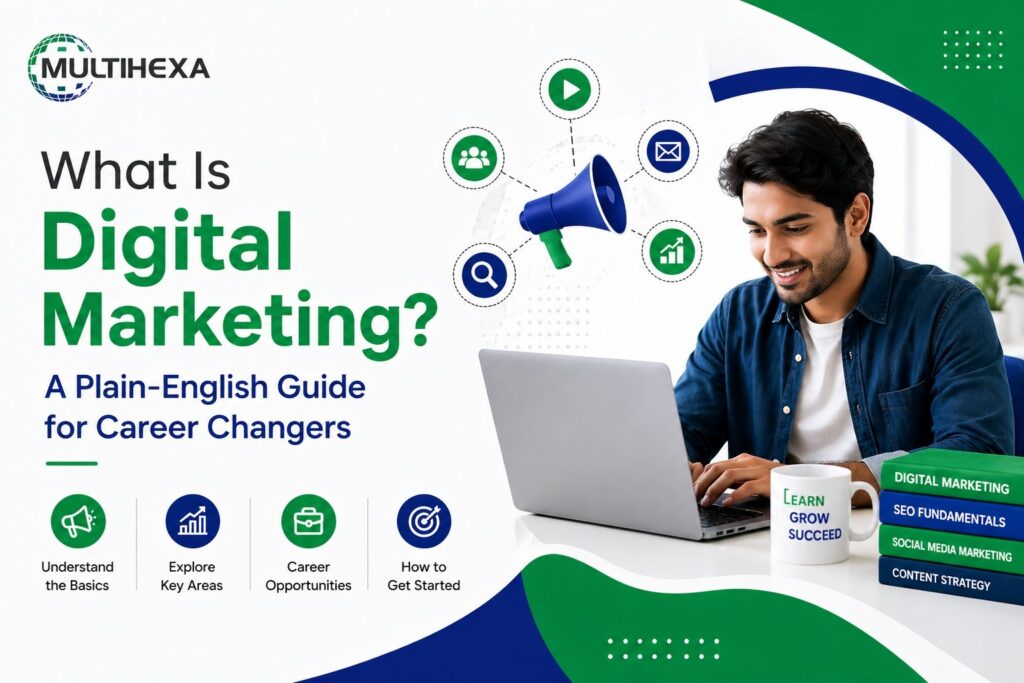
At some point, this question starts coming into every graduate student’s mind or someone who is looking out for a career transition.
“What is digital marketing, and can I actually build a career in it?”
And this question usually comes after a phase when your current job starts feeling limited and redundant. You see your colleagues getting promotions, people around you switching into roles that sound more futuristic, analytical, and digital. You want to search and read about them everywhere, but they are too-technical explanations.
So instead of explaining to you with another definition or pointers blog, we are here to guide you in a way that solves your queries; let’s approach this the way most people actually think.
What Is Digital Marketing?
Digital marketing is how businesses do certain activities and spend money to attract and convert customers using online platforms and social media channels.
Which
- search engines like Google, Yahoo, and Bing
- social media platforms like Meta and LinkedIn
- websites and landing pages
- email and WhatsApp communication
But only understanding definitions won’t help you unless you connect your understanding to the real user behavior.
Think about the last time you:
- searched for a course or any product, even a service as well
- You might have even compared options online
- clicked on paid ads
- A few users even read a blog or article online before making any purchase decisions.
This entire journey, from search to customer decision making, is shaped and regulated by digital marketing fundamentals.
What Is Web And Digital Marketing?
A lot of beginners confuse these two up: web and digital marketing. Although they’re related, they are not identical.
When we talk about digital marketing, it is more about the broader system that includes everything from SEO to ads to content and analytics, even social media.
Whereas website marketing is more focused on the website, it deals with what happens on the website alone, how it looks on the front end following the brand guideline, how easy it is to use, and how fast it loads, and, most importantly, whether it is converting the visitors of the website.
You can also say:
Digital marketing gets people to your website. Web marketing decides whether those people stay, trust you, and take action. That’s why a lot of marketers don’t just focus on bringing more traffic but getting that traffic to actually make purchase decisions.
Types of Digital Marketing Explained
When you start reading about a digital marketing beginner guide, you might come across multiple channels and systems, but it’s important to understand that no system gives results in isolation; they give results when done collectively.
Search Engine Optimization (SEO)
This is something valuable and a demand-driven concept you learn in the digital marketing concept. SEO is something that helps a website appear on top of any search engine like Google without paying the platform fees or marketing charges. It is done with the help of targeting the right keywords strategically.
But during that time, even SEO has evolved a lot; it’s not just about keywords anymore. It’s about understanding:
- what people are searching
- how useful your content is
- how well your website performs
Search Engine Marketing (SEM)
SEM, or Search Engine Marketing, is the paid side of search-driven queries.
It is done by businesses that want immediate visibility on the search engine; then they run ads targeting specific keywords. That’s why when you search for something, the first few results are often shown as “Sponsored.”
This is not something you see randomly; they’re placed strategically to capture high-intent users on the top page of results.
SEO vs. SEM Difference Explained
Honestly, we have seen a lot of beginners who are confused here; they assume they are similar things. And the SEO vs. SEM difference becomes clear when you look at the intent and timelines in bringing the results.
SEO is about building long-term visibility. You invest time in content and optimization so your website ranks naturally and keeps bringing traffic over time.
SEM, on the other hand, means you try to get ranking instantly on platforms by paying for the ads where users are already searching for something specific.
In practice, a lot of businesses don’t choose between the two, they try to keep a balance of both based on the business goals, budget, and timelines.
Social Media Marketing
We all love to hang out on social media, but for brands and businesses it is less about staying less online and more about staying relevant. Brands use it for:
- Staying visible online
- Building familiarity and community on social media
- Creating engagement
It plays a supporting role in the overall marketing ecosystem, often building and influencing decisions online.
Content Marketing
Content is what ties everything together, be it any blog, any video tutorial, or any visual content They are not just pieces of information; they are designed to:
- Answer real questions
- Build trusts
- Move users closer to the traction
This is why strong content is essential for both social and overall media objectives.
What Does A Digital Marketer Do?
At a basic level, the role is about connecting business goals with user behavior online.
That means:
- understanding what people are searching or interested in
- creating content or campaigns around those needs
- bringing users through search, ads, or social platforms
- analyzing what’s working
- improving results continuously
It’s not a repetitive job. It’s a role that evolves with platforms, data, and audience behavior.
What Skills Do You Need For Digital Marketing?
A lot of people hesitate to ask what skills they need because they assume they need a marketing background or an MBA to enter a digital marketing career.
As a digital marketer, you should understand how search engines work, the algorithms, how content influences your audience decisions, and how data helps improve outcomes.
You also learn analytical tools and platforms, making dashboards to drive insights. But you should apply marketing concepts that you have already learned, this is something important.
If your goal is to build skills in a digital marketing career, you can explore a Digital Marketing Diploma Program In Canada that can help you avoid any confusion and focus on practical skills.
How To Get Into Digital Marketing With No Experience
If you are wondering “how to get into digital marketing with no experience,” honestly you are not alone; it happens to a lot of people who join this industry as a fresher. They start by watching random videos, which only results in a lack of information and a clear direction.
You don’t need to know everything, but you should apply whatever you have learned even if it is a small project. For example, if you learn SEO, try writing an SEO-friendly blog and see how it performs.
Over time you will start understanding how search works, how ads work, and how the audience consumes content.
Is Digital Marketing A Good Career In Canada?
If you’re seriously considering a digital marketing career in Vancouver, you must know that the demand for digital marketers is real.
Businesses across industries are heavily investing in digital channels where their customers are, creating opportunities for roles like SEO, content, social media, and paid marketing.
So when people ask, “is digital marketing a good career in Canada?” The honest answer is: yes, but only if you focus on execution and not on learning theory.
How Quickly Can You Learn Digital And Web Marketing
If you are evaluating the next step that is to learn digital through a structured training program, here is the snapshot of the duration of the program:
| Component | Details |
| Duration | 1530 hours / 72 weeks |
| Format | In-class/ Distance/ Combined |
| Credential | Diploma |
What You Build Through The Program:
A strong and structured program will not only teach you marketing but also build the right foundation.
You will learn how to:
- design and manage websites, including CMS platforms
- apply SEO, content, and digital strategies
- understand marketing frameworks like the 4Ps and consumer behavior
- analyze data and make decisions based on insights
- write structured content like blogs, reports, and research
You also gain exposure to:
- business fundamentals and financial thinking
- organizational behavior and decision-making
- tools like Microsoft Office and analytics platforms
Final Thoughts
Digital marketing is not an overnight skill; it comes with practice, exposure, and execution. But it is also something where you can start from scratch and build something meaningful.
And if you’re actually serious about this career path, you can explore the Web and Digital Marketing Diploma Program, to understand how you can fast track your career from learning basic fundamentals to building job-ready skills.
FAQs
- What is Digital Marketing?
Digital marketing is simply how businesses promote themselves online through platforms such as Google, social media, emails, and WhatsApp.
- What is the difference between SEO and SEM?
SEO focuses on improving organic traffic for the business by creating relevant content and targeting keywords, while SEM i.e., Search Engine Marketing, focuses on using paid advertisements to get user traffic to the business.
- What does a Digital Marketer do?
A digital marketer works on understanding user behavior, plans and executes campaigns, creates online content, and tracks performance.
- What skills do I need to become a Digital Marketer?
You need to combine skills such as working on content, optimizing it through doing SEO keywords, and doing analytical thinking to track performance. You should also have the ability to continuously learn and adapt in a fast-changing environment.